On this page
- Why This Route Works (And Why Sofia Isn’t Always the Better Base)
- Getting from Plovdiv to Rila Monastery: Your Real Options
- Arriving at the Monastery: What to Expect in 2026
- The Monastery Itself: How to Move Through It Well
- Hiking the Monastery Surroundings
- The Seven Rila Lakes: Honest Advice for Day-Trippers
- Where to Eat Near Rila Monastery
- 2026 Budget Reality: What This Day Trip Actually Costs
- Frequently Asked Questions
💰 Click here to see Bulgaria Budget Breakdown
💰 Prices updated: August, 2026. Budget figures are estimates — always verify before travel.
Exchange Rate: $1 USD = €0.86
Daily Budget (per person)
Shoestring: €35.00 – €50.00 ($40.70 – $58.14)
Mid-range: €60.00 – €100.00 ($69.77 – $116.28)
Comfortable: €150.00 – €200.00 ($174.42 – $232.56)
Accommodation (per night)
Hostel/guesthouse: €5.00 – €20.00 ($5.81 – $23.26)
Mid-range hotel: €55.00 – €95.00 ($63.95 – $110.47)
Food (per meal)
Budget meal: €12.00 ($13.95)
Mid-range meal: €25.00 ($29.07)
Upscale meal: €60.00 ($69.77)
Transport
Single metro/bus trip: €0.80 ($0.93)
Monthly transport pass: €25.50 ($29.65)
Why This Route Works (And Why Sofia Isn’t Always the Better Base)
Most travel guides default to Sofia as the launch pad for Rila Monastery — and that makes sense on a map. But in 2026, with Plovdiv‘s tourism infrastructure stronger than ever and the Trakia Motorway running smooth after its 2025 resurfacing, doing this day trip from Plovdiv is genuinely competitive. The drive from Plovdiv to Rila Monastery is roughly 140 kilometres, compared to about 120 kilometres from Sofia. That difference disappears fast when you factor in Sofia’s morning traffic and the time you’d spend getting out of the city centre. From Plovdiv, you’re moving through open countryside within minutes of leaving the hotel.
There’s another reason this route makes sense: Plovdiv attracts a different kind of traveller — someone spending three or four days exploring the Old Town, the Roman ruins, Kapana. Rila Monastery is the natural big excursion from that base. It rounds out a Plovdiv stay perfectly without requiring you to backtrack to Sofia or reroute your entire trip.
Getting from Plovdiv to Rila Monastery: Your Real Options
The monastery sits in a deep river valley in the Rila Mountains, about 1,185 metres above sea level. There is no train that goes anywhere near it. Your realistic options from Plovdiv are: renting a car, joining an organised day tour, or piecing together a bus route. Each has a different trade-off.
By Rental Car
This is the most flexible option and the one most independent travellers choose. From Plovdiv, head west on the Trakia Motorway (A1) toward Sofia, then peel off before the capital toward Samokov and follow the signs south into the Rila Mountains toward the monastery. The last 10 kilometres of road winds through a pine-dense gorge along the Rilska River — the asphalt is good, the curves are tight, and the scenery is genuinely dramatic. Total driving time is around 2 hours 15 minutes under normal conditions. Add 30 minutes in summer peak season when tourist convoys slow the mountain approach. Parking at the monastery complex costs 5 BGN (approximately €2.50 / $2.80) per vehicle as of 2026.

By Organised Day Tour
Several Plovdiv-based tour operators run Rila Monastery day trips departing from the city centre, typically leaving around 8:00–8:30 AM and returning by 6:30–7:00 PM. These tours usually bundle the monastery with a stop at Boyana Church near Sofia on the way back, which is worth factoring in if you haven’t visited yet. Prices range from 55 to 90 BGN (€28–€46 / $30–$50) depending on group size and whether lunch is included. Check operators on Plovdiv’s main tourist strip — several run combined Rila and Rhodopes tours if you want to be efficient with a longer itinerary.
By Public Bus (The Honest Assessment)
It can be done, but it eats your day. From Plovdiv’s Yug (South) bus terminal, you take a bus to Sofia (Central Bus Station), then connect to a Rila Monastery-bound bus from Sofia. Buses from Sofia to the monastery typically run twice daily — morning and early afternoon — and the monastery-bound service gets you there around midday at best. That leaves you roughly 2–3 hours before you need to start heading back. It’s manageable but rushed. In summer 2026, there are also occasional direct minibus services from Sofia organised by private operators — worth checking closer to your travel date.
Arriving at the Monastery: What to Expect in 2026
Rila Monastery is Bulgaria’s most visited tourist site, a UNESCO World Heritage Site since 1983, and an active Eastern Orthodox monastery simultaneously. That combination creates a specific atmosphere — somewhere between museum, pilgrimage site, and hiking destination. In 2026, entry to the main courtyard remains free. There is a charge of 10 BGN (€5.10 / $5.60) to access the National History Museum inside the monastery’s Hrelyo Tower complex.

Crowd management has improved since 2024. The monastery introduced timed-entry suggestions for large tour groups, which has reduced the bottleneck that used to form at the main gate between 10 AM and noon. If you arrive before 9:30 AM, you will have the courtyard almost to yourself. By 11 AM on any summer weekend, it’s busy. The smell of incense drifting from the main church mingles with pine-scented mountain air — it sounds like a cliché until you’re standing in the courtyard and actually notice it cutting through the morning cool.
Dress code is enforced. Both men and women need covered shoulders and knees to enter the church. Shawls and wraps are available to borrow at the gate, but bring your own to avoid the queue. Photography inside the main church (the Nativity Church) is not permitted. Outside in the courtyard is fine.
The Monastery Itself: How to Move Through It Well
The complex is larger than it looks from photos. The outer walls form a rough rectangle around a central courtyard, and most visitors make the mistake of spending all their time in the middle, photographing the church exterior, and then leaving. That takes about 20 minutes. A proper visit takes 1.5 to 2 hours if you go methodically.
The Nativity Church
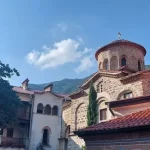
The monastery’s main church was built in the 19th century and its exterior is covered in alternating bands of red and black stone with arched frescoes running along the portico. The frescoes depict scenes of heaven, purgatory, and hell with a visual directness that hasn’t faded despite their age. Spend time here. The ceiling of the outer portico alone is worth 15 minutes of looking.

Hrelyo’s Tower
Built in 1334, this is the oldest surviving structure on the site — a medieval defence tower rising above the roofline of the rest of the complex. The museum inside holds religious artefacts, manuscripts, and historical exhibits about the monastery’s foundation and various destructions over the centuries. The view from the top over the courtyard and the surrounding mountain slopes is the best perspective you’ll get of the whole site.
The Monks’ Cells and Upper Levels
The wooden balconied galleries stacked four levels high around the courtyard are the monks’ living quarters. You can walk the lower-level corridors and look up at the layered balconies with their hand-carved railings — the woodwork here is genuinely extraordinary, all done without nails in the traditional Bulgarian revival style. Upper levels are closed to visitors.
The Ossuary
A short walk outside the main complex, the monastery’s ossuary is small and rarely visited. It contains the bones of monks and is a sobering, quiet space that feels very different from the busy courtyard. Not for everyone, but worth knowing it’s there if you want a moment of quiet.
Hiking the Monastery Surroundings
Most day-trippers from Plovdiv never move more than 200 metres from the monastery entrance, which means the trails fanning out into the valley are remarkably quiet even on busy days. If you’ve budgeted 4–5 hours at the site rather than just 2, you have real options.
The trail along the Rilska River heading south from the monastery is flat, shaded by old-growth forest, and takes you away from the crowds within 10 minutes. After about 1.5 kilometres you reach a small waterfall and a series of stone pools that local hikers use for cooling off in summer. The trail surface is mixed — packed earth and loose rock — so proper shoes matter. The air here in the gorge is noticeably cooler and damper than at the monastery itself, with the sound of the river bouncing off the canyon walls.

For something more elevated, the trail heading uphill behind the monastery leads toward the Kiril Meadow (Kirilova Polyana) and eventually connects to the network of mountain huts and peaks in the upper Rila range. You don’t need to go far — even 45 minutes of climbing gives you a view back down into the valley and across the forested ridges that makes the effort worthwhile. This section of trail is well-marked with the standard Bulgarian trail signs (red and white blazes).
The Seven Rila Lakes: Honest Advice for Day-Trippers
The Seven Rila Lakes are one of Bulgaria’s most iconic landscapes — a chain of glacial lakes at around 2,100 to 2,500 metres altitude, each named for a physical characteristic (the Teardrop, the Eye, the Twin, and so on). They are spectacular. They are also not easy to combine with a Rila Monastery day trip from Plovdiv.
The lakes are accessed from a different direction, primarily via Panichishte or via the Rila Lakes gondola lift near Samokov. If you’re driving from Plovdiv, you’d need to choose one or the other — monastery or lakes — unless you have a very early start (before 7 AM) and are comfortable with a long, tiring day with minimal margin for error. Doing both properly requires two separate days.
The honest answer: if you have one day and you’re based in Plovdiv, go to the monastery. The lakes are best approached from Sofia with a full day dedicated solely to them. Save that for a different trip, or a longer stay in Bulgaria.

Where to Eat Near Rila Monastery
Food options near the monastery are limited but functional. The village of Rila, about 10 kilometres north down the valley, has a small number of traditional mehanas (Bulgarian taverns) serving grilled meats, shopska salad, and bean soup. These are simple, filling, and reasonably priced. Expect to pay 15–25 BGN (€7.50–€13 / $8–$14) for a full meal with a drink.
Directly at the monastery complex, there are a few stalls and a small café selling coffee, banitsa (cheese-filled pastry), and packaged snacks. The banitsa here is made fresh in the morning — the pastry is warm and flaky, with a slightly salty bite that pairs well with a strong espresso before you start exploring. Don’t expect a full meal from these stalls, but they’re fine for a quick breakfast on arrival if you’ve come straight from Plovdiv.
There’s also the Rilets tourist complex about 2 kilometres from the monastery with a larger restaurant, though quality and service are inconsistent. If you’re organised, pack your own lunch from Plovdiv — the trail along the river provides excellent picnic spots with benches and mountain views that beat any restaurant setting on the route.
2026 Budget Reality: What This Day Trip Actually Costs
Prices below reflect 2026 figures. The Bulgarian lev remains pegged to the euro (1 EUR = 1.956 BGN), and Bulgaria continues to operate with lev as its currency in 2026 pending eurozone entry, currently projected for 2027.
Budget Tier (Public Transport + Self-Catering)
- Bus Plovdiv–Sofia: 15–18 BGN (€7.50–€9.20)
- Bus Sofia–Rila Monastery (return): 20–24 BGN (€10–€12)
- Monastery museum entry: 10 BGN (€5.10)
- Food (packed lunch + snacks on-site): 12–15 BGN (€6–€7.50)
- Total: approximately 57–67 BGN (€29–€34 / $32–$38)
Mid-Range Tier (Rental Car + Meals Out)
- Car rental (economy, one day, from Plovdiv): 70–90 BGN (€36–€46)
- Fuel (Plovdiv–Rila–Plovdiv, roughly 280 km total): 35–42 BGN (€18–€21)
- Parking at monastery: 5 BGN (€2.50)
- Monastery museum entry: 10 BGN (€5.10)
- Lunch at Rila village mehana: 20–28 BGN (€10–€14) per person
- Total per person (solo): approximately 140–175 BGN (€72–€90 / $80–$100)
- Total per person (two people sharing car): approximately 90–110 BGN (€46–€56 / $51–$62)

Comfortable Tier (Private Tour or Guided Day Trip)
- Private guided day tour from Plovdiv (for 2): 180–260 BGN per person (€92–€133)
- This typically includes transport, guide, museum entry, and lunch
- Total: approximately 180–260 BGN per person (€92–€133 / $102–$148)
One cost that surprises some visitors: professional photography inside the monastery grounds (with camera equipment, tripods) requires a separate permit purchased at the gate. Smartphone photography in the courtyard is free and unrestricted.
Frequently Asked Questions
How long does the drive from Plovdiv to Rila Monastery take?
Expect around 2 hours 15 minutes under normal conditions. In summer peak season (July–August), add 20–30 minutes for traffic on the mountain approach road. The route goes via the Trakia Motorway toward Sofia, then south through Samokov and into the Rila gorge. Road conditions are good throughout in 2026.
Is there a direct bus from Plovdiv to Rila Monastery?
No direct service exists in 2026. You need to travel to Sofia first, then connect to the monastery bus from Sofia’s Central Bus Station. Buses from Sofia to Rila Monastery typically run twice daily in summer. The full journey takes 3.5–4.5 hours each way, making it a very long day on public transport.
What is the entry fee for Rila Monastery in 2026?
Entry to the main courtyard is free. The National History Museum inside the complex costs 10 BGN (approximately €5.10 / $5.60). Parking outside the monastery is 5 BGN per vehicle. The main church is free to enter but photography inside is strictly prohibited. Budget around 15 BGN total per person for all paid access.
What should I wear to visit Rila Monastery?
Dress code is enforced year-round. Covered shoulders and knees are required to enter the church. Shawls and wraps are available to borrow at the entrance gate, but there’s often a queue. Bring your own cover-up to save time. Comfortable walking shoes are recommended — the cobbled courtyard and surrounding trails are uneven in places.
Can I combine Rila Monastery with the Seven Rila Lakes in one day from Plovdiv?
Technically possible but not recommended. The lakes and the monastery are accessed from different directions, and doing both properly requires over 12 hours of travelling and rushing. From Plovdiv, choose one destination per day. The monastery makes the stronger standalone day trip; the lakes are better approached as a dedicated excursion from Sofia or a mountain base.
Explore more
Best Places to Eat in Plovdiv, Bulgaria — Where to Find Great Food
Plovdiv Nightlife Guide: Where to Party Until Dawn
Where to Eat in Plovdiv: Your Ultimate Foodie Itinerary
📷 Featured image by Mihail Dimitrov on Unsplash.