On this page
- Understanding Plovdiv’s Layout Before You Plan Any Journey
- Trams and Trolleybuses — What Still Runs and Where
- City Buses — Routes That Actually Matter for Visitors
- Taxis and Ride-Hailing Apps in 2026
- Walking Plovdiv — The Old Town, the Kapana, and What’s in Between
- Renting a Bike or Scooter — The 2026 Options
- 2026 Budget Reality — What Getting Around Plovdiv Actually Costs
- Getting from Plovdiv Airport and Train Station to the Centre
- Frequently Asked Questions
Since Bulgaria joined the Schengen zone in 2024 and direct flight routes into Plovdiv International Airport multiplied through 2025, the city has seen a sharp rise in first-time visitors who arrive with no idea how to get from point A to point B. Plovdiv is not a difficult city to navigate — but it is an unusual one, and the standard advice you find on outdated travel forums will send you waiting at a bus stop that was rerouted two years ago. This guide reflects how the city actually works in 2026.
Understanding Plovdiv’s Layout Before You Plan Any Journey
Before you open any map app, it helps to understand Plovdiv’s physical logic. The city is built around three distinct zones, and knowing which zone you are in tells you immediately which transport type makes sense.
The Old Town (Staria Grad) sits on and around three of Plovdiv’s famous hills — Nebet Tepe, Dzhambaz Tepe, and Taxim Tepe. The streets here are cobblestone, steep, and completely inaccessible to buses. No vehicle larger than a small taxi gets through most of it. If your accommodation is in the Old Town, your legs are your primary transport.
The city centre — the pedestrian main street (ul. Knyaz Alexander I), the Kapana creative district immediately to the west, and the surrounding grid of streets — is flat, walkable, and well-served by public transport on its edges. The central post office area and pl. Tsentralen (Central Square) act as natural reference points.
The residential districts — Kamenitsa, Trakiya, Filipovo, Lauta, Hristo Smirnenski — spread outward from the centre and are where most public bus lines actually go. Unless you are visiting a specific neighbourhood, you are unlikely to need buses heading deep into these areas.
One more thing to understand: the Maritsa River cuts through the southern part of the city. Several bridges cross it, and this matters when you are working out walking or cycling routes toward the Plovdiv Fair grounds or the Rowing Canal area.

Trams and Trolleybuses — What Still Runs and Where
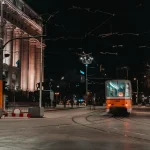
Plovdiv has a small tram network and a trolleybus system that confuses visitors because neither covers the centre directly — they run along the main boulevards that ring it.
Tram lines in Plovdiv are limited. As of 2026, the most useful for visitors is the line running along Bulevard Hristo Botev and connecting toward the train station area and the Trakiya district. The trams are older rolling stock but they run reliably and on schedule during peak hours. Off-peak, expect gaps of 15 to 20 minutes between cars.
Trolleybuses cover slightly more ground and are quieter than diesel buses. The trolleybus routes along Bulevard Vassil Aprilov and Bulevard 6 Septemvri are the ones that drop you closest to the Kapana district and the edges of the pedestrian zone. From those stops, you are typically a 5 to 8 minute walk from the main street.
The sound of a trolleybus pulling away — that low electric hum and the slight crackle of the overhead wire — is oddly satisfying once you get used to it. These vehicles move through the boulevard traffic more smoothly than buses during rush hour because they are not fighting for diesel power in slow traffic.
Both trams and trolleybuses use the same ticketing system as city buses (see the next section). You buy a ticket before boarding or use a contactless card at the validator on board — a system that was upgraded across Plovdiv’s fleet in late 2024.

City Buses — Routes That Actually Matter for Visitors
Plovdiv’s city bus network is run by Gradski Transport Plovdiv and covers the entire urban area. The full route map looks intimidating, but visitors typically only need four or five lines.
Bus 20 connects the central area with the Plovdiv Fair grounds (Panair) to the south — useful during the large trade fairs that fill the city several times a year, most notably the Plovdiv International Fair in September. If you are in the city during a fair week, this bus gets very crowded by 9:00.
Bus 44 runs from the train station through the city centre toward the Trakiya residential district. This is the one most travellers arriving by rail will use if they do not take a taxi.
Bus 29 and Bus 99 are the most used by visitors staying in the Kapana area who want to reach outlying neighbourhoods or the southern side of the river without walking 30 minutes.
The city has continued expanding real-time digital displays at major stops — by mid-2026, around 60% of the main stops in the central zone have screens showing actual arrival times rather than scheduled times. The Plovdiv Transport mobile app (available on Android and iOS as of 2025) also gives live tracking, though coverage can drop in the hilly areas near the Old Town.
Bus frequency varies significantly. On main boulevards during weekday rush hours, you might see a bus every 8 minutes. On weekend afternoons on the same route, it could be every 20 to 25 minutes. Plan around this if you have a specific time to hit.
Taxis and Ride-Hailing Apps in 2026
Plovdiv’s taxi scene has changed considerably since 2024. The old problem of unlicensed drivers overcharging tourists at the train station and airport has been reduced — but not eliminated — by better enforcement and the growth of app-based booking.

OK Supertrans and Yellow Taxi Plovdiv are the two most established local companies with metered vehicles. Both have their own booking apps, though neither has the polish of international platforms. The meter start rate in 2026 is approximately 1.30 BGN (0.65 EUR) with a per-kilometre rate of around 1.10 to 1.20 BGN (0.55–0.60 EUR) during the day.
Bolt operates in Plovdiv and is the most reliable ride-hailing option for non-Bulgarian speakers. The app works seamlessly, prices are shown upfront, and drivers are rated. As of 2026, Bolt has significantly expanded its Plovdiv driver pool compared to 2023, so wait times in the centre are usually 3 to 6 minutes. In the Old Town, drivers will meet you at the nearest accessible street rather than climbing the cobblestone alleys.
Uber re-entered the Bulgarian market in late 2025 after a prolonged absence and now operates in Plovdiv, though with a smaller driver pool than Bolt. Worth having both apps installed and comparing prices for longer rides.
One practical note: always confirm the destination in the app or show the driver the address on your phone. Even experienced drivers occasionally confuse street names in the Old Town because several old streets were renamed during the 2019 European Capital of Culture year and some GPS databases still use the old names.
Walking Plovdiv — The Old Town, the Kapana, and What’s in Between
For most visitors, walking is not just a transport option in Plovdiv — it is the experience itself. The city’s compact historic core means that a surprising number of sights are within 20 minutes on foot from each other, even if the terrain makes it feel longer.
The Old Town is built for slow walking. The cobblestones are irregular and some sections are quite steep, particularly heading up toward Nebet Tepe or the Ethnographic Museum on Dr. Chomakov Street. Wear shoes with grip. In wet weather the stone gets genuinely slippery — this is not an exaggeration. The reward is that every turn reveals a National Revival-era house facade in ochre, green, or blue, often with the upper storeys jutting out dramatically over the lane below.

The Kapana district — the name means “the trap” in Bulgarian, referring to the old maze-like layout of workshops — sits just west of the main pedestrian street and is completely flat. Its compact grid of small streets is lined with independent cafés, studios, bars, and galleries. On a warm evening you can smell fresh coffee and grilled food from half a block away as the kitchen vents of a dozen small restaurants pour out into the street. This is the part of Plovdiv that has gentrified most visibly since 2019 and it rewards aimless walking more than any planned route.
Between the Old Town and Kapana, the main pedestrian street (ul. Knyaz Alexander I) connects them east to west for about 1.5 kilometres. This is flat, wide, and completely car-free. It passes the Dzhumaya Mosque, the Roman Stadium ruins (visible through a glass floor section), and leads to pl. Tsentralen. Walking it end-to-end takes about 20 minutes at a relaxed pace.
If you want to cross the river on foot, the Tsar Simeon Garden on the south bank is an easy walk from the centre via the Knyaz Nadezhda bridge, and the garden itself is worth 30 minutes of wandering — it is one of the oldest public parks in Bulgaria and far less visited than the Old Town.
Renting a Bike or Scooter — The 2026 Options
Cycling in Plovdiv has become significantly more practical since the city expanded its dedicated cycling infrastructure between 2023 and 2025. There are now marked cycle lanes along several of the main boulevards, and a riverside path runs for several kilometres along both banks of the Maritsa — largely flat and very pleasant on dry days.

The city does not yet have a fully integrated public bike-share scheme comparable to Sofia’s. Instead, several private rental shops operate near the Old Town and the Kapana area. Expect to pay around 15 to 20 BGN (7.50–10 EUR) for a full day’s rental of a standard city bike. Electric bikes are available at some shops for 30 to 40 BGN (15–20 EUR) per day.
Electric scooters (e-scooters) from Bird and a local operator called SpeedUp are dockless and available throughout the central area. You unlock them via app, pay per minute, and leave them at any approved parking zone. The per-minute rate in 2026 is approximately 0.25 to 0.30 BGN (0.12–0.15 EUR), with a 1 BGN unlock fee. For a 15-minute ride across the centre, expect to pay around 5 to 6 BGN total.
One realistic limitation: neither bikes nor scooters work well in the Old Town. The cobblestones are rough, the inclines are steep, and scooter parking zones do not extend into the pedestrian hill areas. Use them for the flat centre, the riverside, and the boulevard routes. Leave them at the edge of the Old Town and walk up.
2026 Budget Reality — What Getting Around Plovdiv Actually Costs
Here is a practical breakdown of transport costs you will actually encounter in 2026:
- Single public transport ticket (bus, tram, trolleybus): 1.60 BGN (0.80 EUR / approx. 0.87 USD)
- Day pass (unlimited public transport): 4.00 BGN (2.00 EUR)
- Short taxi ride in the centre (up to 3 km): 6 to 9 BGN (3.00–4.50 EUR)
- Bolt ride — train station to Old Town (approx. 3.5 km): 7 to 10 BGN (3.50–5.00 EUR)
- Bolt ride — airport to city centre (approx. 12 km): 20 to 28 BGN (10–14 EUR)
- City bike rental — half day: 10 to 12 BGN (5.00–6.00 EUR)
- E-scooter — 20-minute ride: 7 to 8 BGN (3.50–4.00 EUR)

Budget traveller: If you stay central and walk most of the time, your daily transport cost can be as low as 0 to 5 BGN. Use the day pass only on days when you plan three or more public transport trips.
Mid-range traveller: Mix of walking, occasional Bolt rides for evening returns from the Old Town (uphill back to your hotel), and one or two bus trips. Budget roughly 20 to 35 BGN (10–17 EUR) per day for transport.
Comfortable traveller: Primarily using Bolt or taxis with a bike rental for one day of river cycling. Expect 40 to 70 BGN (20–35 EUR) per day depending on distances and frequency.
Compared to 2023 prices, public transport fares rose by about 15% following a 2024 city council revision, but taxi and ride-hailing rates have remained relatively stable due to competition between Bolt and the newly returned Uber.
Getting from Plovdiv Airport and Train Station to the Centre
Plovdiv International Airport is located approximately 12 kilometres north of the city centre, near the village of Krumovo. As of 2026, there is still no direct rail link or metro connection to the airport — this has been discussed for years and remains unbuilt. Your options are:
- Bus 15 connects the airport with the central bus terminal. The journey takes 25 to 35 minutes depending on traffic, and the bus runs roughly every 30 to 40 minutes. Fare: 1.60 BGN. This is the cheapest option but requires knowing the schedule and can be slow with luggage during peak times.
- Bolt or taxi: 20 to 28 BGN (10–14 EUR) to the centre, 15 to 20 minutes on a clear day. This is by far the most practical option for most visitors, especially those arriving late or with luggage. Book via the Bolt app before you land to avoid the taxi queue outside arrivals.
- Pre-arranged transfer: Several companies offer fixed-price airport transfers for 35 to 50 BGN (17–25 EUR) with a meet-and-greet inside the terminal. Slightly more expensive than Bolt but useful if you are arriving for the first time and want certainty.

Plovdiv Central Train Station sits about 2 kilometres southwest of the main pedestrian zone. It is a straightforward journey from here:
- Walking: 20 to 25 minutes along Bulevard Hristo Botev heading northeast — flat, direct, manageable with a single bag but tiring with heavy luggage.
- Bus 44 or tram: Departs from directly in front of the station, 1.60 BGN, drops you near the Central Square area in about 10 minutes.
- Bolt: Typically 5 to 8 BGN from the station to anywhere in the centre. Wait times are usually under 5 minutes.
The train station area is currently undergoing partial renovation as part of a National Railway Infrastructure Company modernisation programme begun in 2025. Expect some entrance access changes depending on the phase of construction when you arrive. The main hall and ticketing remain open throughout.
Frequently Asked Questions
Is Plovdiv easy to navigate without speaking Bulgarian?
Yes, for the most part. The centre and Old Town are compact and walkable. Bolt and Uber remove the language barrier for taxis entirely. Bus stop names are transliterated on the Plovdiv Transport app. Street signs in the central zone are bilingual in Bulgarian and Latin script since 2020. You do not need Bulgarian to get around comfortably as a visitor.
Can I use a credit card on Plovdiv buses and trams?
Yes. Since the contactless payment upgrade rolled out across the fleet in early 2025, you can tap a Visa or Mastercard contactless card or a compatible phone directly on the validator when boarding. Paper tickets are still sold at kiosks and some newsstands if you prefer, but you no longer need them.

Is it safe to walk around Plovdiv at night?
The Old Town, Kapana, and the main pedestrian street are safe and active well past midnight, especially on weekends. The area around the train station and some outer residential districts are less well-lit and worth avoiding late at night if you are unfamiliar with the city. Stick to the centre after dark and you will have no concerns.
How long does it take to walk across the city centre?
From the western edge of Kapana to the far end of the Old Town’s highest hill is roughly 3 kilometres. On flat ground that takes about 35 minutes. Factor in the Old Town hills and cobblestones and budget closer to 50 to 60 minutes for the full east-west crossing at a comfortable pace. Most visitors find that central Plovdiv is far more walkable than it looks on a map.
Are there any transport apps that work specifically for Plovdiv?
The official Plovdiv Transport app (launched 2025) gives live bus and tram tracking with English-language support. Bolt is the most reliable ride-hailing app in the city. Google Maps has reasonably accurate public transport data for Plovdiv as of 2026, though it occasionally lags a few weeks behind route changes. Moovit also covers Plovdiv and is a solid backup for route planning.
Explore more
Best Day Trips from Plovdiv: Your Ultimate Guide to Bulgarian Wonders
Where to Stay in Plovdiv: The Ultimate Neighborhood Guide
Plovdiv to Rila Monastery: A Day Trip Itinerary You Can’t Miss
📷 Featured image by Virginia Marinova on Unsplash.